A pun is a form of wordplay that uses words with multiple meanings or similar sounds to create humor, cleverness, or a surprising twist.
Example: “I used to be a baker, but I couldn’t make enough dough.” Here, “dough” refers to both bread mixture and money.
Have you ever heard a joke that made you smile because one word had two different meanings? Perhaps someone said, “I’m reading a book about anti-gravity. It’s impossible to put down!” That clever use of language is called a pun.
Understanding puns meaning helps you appreciate one of the most creative features of the English language. Puns appear in everyday conversations, comedy, advertisements, greeting cards, social media captions, literature, and even professional communication. They can make a simple sentence memorable by connecting meanings that people do not usually associate with each other.
A pun is not necessarily a long joke. Sometimes, one carefully chosen word is enough to make a sentence funny. Other puns depend on pronunciation, spelling, familiar expressions, or unexpected interpretations. The best examples are easy to understand, relevant to the situation, and enjoyable without requiring a lengthy explanation.
This guide explores what a pun means, how wordplay works, the different types of puns, and hundreds of original-style examples you can use to understand the concept. You will also discover how to create your own puns, recognize them in conversations, and choose appropriate examples for friends, family, school, work, and social media.
1. What Does Pun Mean in English?
A pun is a humorous or clever expression that plays with words, sounds, or meanings. It often combines two interpretations of a word or phrase, creating a surprising connection that makes the sentence entertaining.
For example, “The bicycle couldn’t stand alone because it was two-tired.” The word “tired” sounds like “tyred,” referring to the bicycle’s tires. The humor comes from connecting a familiar expression with a literal description of the bicycle.
Here are 15 examples illustrating the basic meaning of puns.
- The calendar felt its days were numbered.
- The pencil had a point to make.
- The musician found the situation note-worthy.
- The gardener planted ideas for future growth.
- The clock enjoyed spending quality time together.
- The baker made enough dough for everyone.
- The librarian checked out every interesting possibility.
- The electrician had shocking news to share.
- The photographer developed a bright new perspective.
- The tailor made a fitting observation.
- The mathematician found the problem quite divisive.
- The gardener’s business continued growing every season.
- The artist drew attention without saying anything.
- The comedian delivered a punchline with perfect timing.
- The writer found the right words eventually.
2. What Is a Pun in Simple Words?
In simple words, a pun is a play on words. It uses a word or phrase in a clever way, usually because it has more than one meaning or resembles another word in sound.
Think of the sentence, “I wondered why the ball was getting bigger. Then it hit me.” The expression “it hit me” can mean that something physically struck someone or that the person suddenly understood something.
Puns are popular because they turn ordinary language into something unexpected. You do not need advanced vocabulary to understand or create them.
Here are 15 simple puns for beginners.
- The cat had a purr-fectly wonderful afternoon.
- The sleepy student needed a little class.
- The shoe store had many sole-searchers.
- The banana slipped into another peel.
- The cookie felt crumby after the argument.
- The frog enjoyed a ribbit-ing conversation.
- The bee had a buzz-worthy idea.
- The tomato blushed when it saw salad.
- The owl considered every option very wisely.
- The blanket covered every important detail.
- The egg told an egg-cellent story.
- The snail left everyone in its trail.
- The apple stayed core-focused throughout lunch.
- The dog found the meeting paws-itively delightful.
- The orange concentrated on its zestful future.
3. What Is the Meaning of a Pun Joke?
A pun joke is a joke whose humor depends on wordplay. Instead of relying entirely on a surprising situation, it uses language to create an amusing double meaning or sound-based connection.
For example, “Why did the math book look sad? It had too many problems.” The word “problems” refers both to mathematical exercises and to difficulties in life.
Pun jokes are often short, making them suitable for casual conversations, classroom activities, greeting cards, and social media captions.
Here are 15 original-style pun jokes.
- The calendar went on vacation because it needed dates.
- The baker quit because business was getting crumby.
- The clock applied for work because time was money.
- The gardener became famous after branching into entertainment.
- The pencil retired after making its final point.
- The musician relaxed because everything was in tune.
- The chef remained calm under intense pressure.
- The tailor succeeded because every decision fit perfectly.
- The photographer smiled because things developed nicely.
- The librarian stayed quiet about her novel ideas.
- The electrician celebrated after connecting with everyone.
- The dentist enjoyed work because it was filling.
- The astronaut needed space for personal growth.
- The detective solved the case by following clues.
- The comedian earned applause by delivering a timely joke.
4. What Are the Different Types of Puns?
Puns come in several forms. Some depend on words with multiple meanings, while others use similar sounds, spelling, or familiar expressions. Understanding these categories makes it easier to recognize wordplay and write your own examples.
The main types include homophonic puns, homographic puns, and homonymic puns. Writers also use compound puns, visual puns, idiom-based puns, and creative combinations that do not fit neatly into one category.
Here are 15 examples representing different approaches to wordplay.
- The fisherman found the whole situation reely interesting.
- The baker kneaded a little extra dough.
- The gardener’s ideas blossomed into a thriving business.
- The musician struck the right chord emotionally.
- The tailor’s explanation suited everyone in attendance.
- The photographer captured a moment worth developing.
- The comedian made a point without a pointer.
- The clock’s future looked bright by the hour.
- The student excelled because she studied her subjects.
- The chef seasoned his speech with spicy humor.
- The writer’s draft needed a refreshing breeze.
- The architect built a strong case for change.
- The painter brushed aside every unnecessary concern.
- The mechanic drove his argument home convincingly.
- The sailor navigated a sea of possibilities.
5. What Is an Example of a Pun?
A classic example of a pun is, “I used to be a banker, but I lost interest.” The expression “lost interest” refers both to losing enthusiasm and to losing the financial interest associated with banking.
Another example is, “A bicycle cannot stand alone because it is two-tired.” The phrase combines the familiar word “tired” with the idea of a bicycle having two tires.
These examples demonstrate how a single sentence can carry two interpretations without becoming difficult to understand.
Here are 15 additional examples of puns.
- The musician had a natural talent for composition.
- The gardener’s career took root surprisingly quickly.
- The baker’s reputation rose with every loaf.
- The librarian had a shelf-full of ideas.
- The scientist kept her experiments under observation.
- The photographer focused on developing meaningful relationships.
- The carpenter nailed the presentation with confidence.
- The teacher made a class distinction immediately.
- The plumber knew how to handle pressure.
- The painter’s future looked colorful and bright.
- The runner found success by going the distance.
- The chef cooked up a brilliant solution.
- The writer’s words carried considerable weight.
- The dentist’s advice left everyone smiling broadly.
- The astronomer discovered a universe of possibilities.
6. What Is a Double Meaning Pun?
A double meaning pun uses one word or phrase that can be interpreted in two ways. The reader initially understands one meaning, then notices a second interpretation that changes the sentence’s effect.
For example, “The baker’s business was on the rise.” The phrase describes a successful business while also suggesting dough rising during baking.
Double meaning puns work especially well when both interpretations relate naturally to the subject.
Here are 15 double meaning examples.
- The baker’s profits rose with every fresh batch.
- The gardener watched her career continue to grow.
- The musician found harmony in every relationship.
- The photographer developed a positive outlook on life.
- The tailor’s plans were perfectly cut out.
- The carpenter built trust through solid craftsmanship.
- The teacher’s lessons made a lasting impression.
- The athlete overcame obstacles by staying on track.
- The writer kept every promising idea in print.
- The chef handled criticism with a pinch of salt.
- The electrician maintained a bright professional outlook.
- The librarian organized her thoughts into chapters.
- The dentist filled the room with cheerful conversation.
- The sailor kept his plans afloat through storms.
- The mathematician calculated every possible angle carefully.
7. What Is a Homophone Pun?
A homophone pun uses words that sound alike but have different meanings, and sometimes different spellings. The humor depends on recognizing the relationship between those words.
For example, “The knight knew he was right.” The words “knight” and “right” sound similar in English, although their meanings differ.
Homophone puns can help language learners develop listening skills, improve vocabulary, and notice how pronunciation influences humor.
Here are 15 examples using sound-based wordplay.
- The knight knew the answer was right.
- The flower seller flourished in business.
- The baker kneaded dough before sunrise.
- The sailor sailed away without a single sale.
- The deer found the forest atmosphere quite dear.
- The sun’s rays raised everyone’s spirits.
- The seamstress found a seam of opportunity.
- The pair repaired the broken garden gate.
- The writer’s tale included a surprising tail.
- The hare hurried toward the hidden lair.
- The weather changed plans could continue.
- The son learned his lesson from the sun.
- The blue bird blew past the window.
- The maid made arrangements before the guests arrived.
- The peace treaty brought a piece of hope.
8. What Is a Homograph Pun?
A homograph pun uses words spelled the same way but carrying different meanings. Depending on the word, pronunciation may remain the same or change.
Consider the word “bat.” It can refer to an animal or a piece of sports equipment. A sentence that connects both meanings can create a playful effect.
Homograph puns are especially useful in writing because readers can see the shared spelling immediately.
Here are 15 examples of homograph-based wordplay.
- The baseball player watched a bat fly overhead.
- The farmer had to produce fresh produce.
- The singer’s bass accompanied the bass fisherman.
- The tear in her letter caused a tear.
- The wind helped the sailors wind their ropes.
- The bow decorated her hair before she bowed.
- The lead actor carried lead-colored props.
- The dove flew away as the performer dove.
- The close friends stood close together.
- The minute details took a minute to explain.
- The project had a fine finish.
- The patient learned to object to the objection.
- The evening concert presented a memorable present.
- The record store helped record the event.
- The rowers argued about their row in the boat.
9. What Is a Homonym Pun?
A homonym pun uses a word that shares its spelling or pronunciation with another word but has a different meaning. The precise linguistic classification can vary, because homonyms overlap with homographs and homophones.
For everyday readers, the essential point is simple: one word creates two possible interpretations.
For example, “The duck was ready to duck.” The first “duck” names an animal, while the second describes lowering one’s head or body.
Here are 15 homonym-style examples.
- The duck ducked beneath the garden fence.
- The crane watched another crane lift heavy materials.
- The bark echoed while the dog barked.
- The seal watched the diver seal the container.
- The bat carried a bat toward the field.
- The watchmaker checked his watch before leaving.
- The spring arrived beside the mountain spring.
- The ruler measured the table with a ruler.
- The palm tree stood beside her open palm.
- The match ended after lighting the match.
- The ring around her finger began to ring.
- The can opener rested beside the metal can.
- The fair judge attended the village fair.
- The well was maintained by a well worker.
- The wave disappeared as another wave approached.
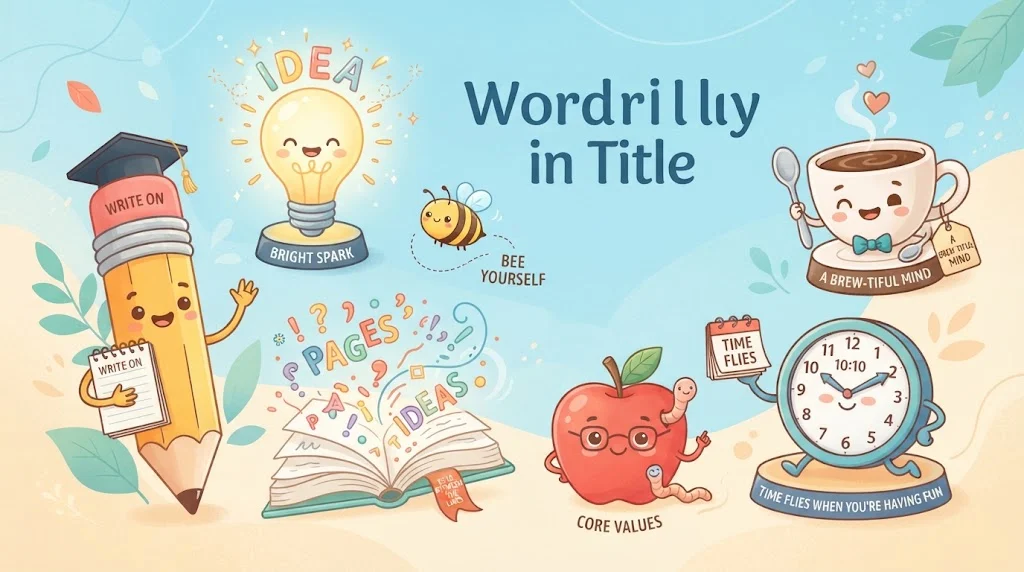
10. What Is a Visual Pun?
A visual pun communicates wordplay through an image rather than words alone. An illustration might combine two objects, symbols, or ideas to represent a familiar expression literally.
For example, an illustration of a smiling sun wearing running shoes could represent the phrase “a bright start.” A picture of a cat sitting beside a calendar marked with dates might communicate a playful dating joke.
Visual puns are common in cartoons, posters, advertising, greeting cards, and social media graphics.
Here are 15 concepts for visual puns.
- A pencil drawing attention toward its point.
- A smiling clock enjoying quality time outdoors.
- A book character literally opening new doors.
- A flower wearing sunglasses on a sunny day.
- A ladder leaning against a growing business chart.
- A lightbulb lifting weights for brighter ideas.
- A fish holding a reel beside water.
- A smiling apple standing beside a core diagram.
- A sleepy moon resting on a pillow.
- A musical note relaxing inside a comfortable chair.
- A camera developing legs and walking forward.
- A cheerful bee buzzing around a letter.
- A loaf of bread rising beside balloons.
- A paintbrush sweeping colorful clouds across the sky.
- A running shoe racing toward a finish line.
11. What Is an Idiom Pun?
An idiom pun plays with an expression whose meaning differs from its literal words. The writer brings the original wording back into focus to create a humorous interpretation.
For example, “The gardener really went out on a limb.” The expression normally means taking a risk, but a gardener might literally climb onto a tree branch.
These puns work well because readers already recognize the original expression.
Here are 15 idiom-based puns.
- The gardener went out on a limb.
- The baker rose to the occasion beautifully.
- The carpenter finally nailed the big presentation.
- The musician struck a chord with listeners.
- The photographer kept every important detail in focus.
- The electrician brightened everyone’s day with kindness.
- The chef added flavor to every conversation.
- The writer turned over a new page.
- The sailor weathered every storm with confidence.
- The runner went the extra mile daily.
- The painter saw things in a different light.
- The librarian brought a story to life.
- The mechanic got things moving again quickly.
- The teacher helped students get the picture.
- The florist stopped beating around the bush.
12. What Is a Compound Pun?
A compound pun combines two or more pieces of wordplay in a single joke. It may connect several meanings, familiar expressions, or related words to create a layered effect.
Compound puns can be clever, but they should remain understandable. If readers must decode too many meanings, the joke can become confusing.
Here are 15 compound pun examples.
- The baker rose early and kneaded encouragement.
- The gardener rooted for growth and branched out.
- The musician tuned in and struck a chord.
- The writer drafted ideas and penned fresh possibilities.
- The tailor measured success and fitted new plans.
- The carpenter built confidence and nailed every challenge.
- The chef stirred excitement and seasoned the conversation.
- The photographer focused carefully and developed new friendships.
- The electrician connected people and sparked brighter ideas.
- The librarian opened books and uncovered new chapters.
- The athlete ran with ideas and crossed boundaries.
- The painter brushed off worries and colored life.
- The dentist filled appointments and brightened every smile.
- The sailor charted plans and navigated uncertain waters.
- The comedian delivered punchlines and lifted every mood.
13. What Is a Pun in Literature?
In literature, a pun is a rhetorical device that uses wordplay to add humor, irony, emphasis, or deeper meaning. Writers may use puns in dialogue, poetry, drama, fiction, and persuasive writing.
A literary pun can make a character sound witty, reveal a hidden intention, or reinforce a theme. It can also create a memorable line that readers remember long after finishing a passage.
Here are 15 original literary-style pun examples.
- Her words planted seeds of quiet understanding.
- The poet found meaning between every line.
- The playwright staged a remarkable turn of phrase.
- The novelist developed characters with layered personalities.
- The editor gave every sentence a second reading.
- The storyteller opened doors through imaginative language.
- The critic weighed every word with care.
- The actor delivered a line with perfect timing.
- The playwright made dramatic changes behind the scenes.
- The poet’s meter measured more than syllables.
- The novelist kept readers hooked on every chapter.
- The editor cut unnecessary words from the draft.
- The storyteller spun tales that held everyone.
- The playwright found room for another scene.
- The poet made silence speak through carefully chosen words.
14. What Is a Pun in Poetry?
A pun in poetry uses wordplay to create rhythm, surprise, humor, or multiple layers of meaning. Poets may place puns at the ends of lines, within rhymes, or around words that connect different ideas.
A pun can make a poem playful without sacrificing its message. It can also create a memorable rhyme or emphasize an image.
Here are 15 short, original poetic pun lines.
- The moon took flight on silver light.
- A flower grew stronger by the hour.
- The clock kept time while dreams climbed.
- The bee found joy among blooms.
- The sea kept secrets beneath its surface.
- A bright idea became a shining star.
- The page turned toward another possibility.
- The sun rose above yesterday’s worries.
- A little thyme made every moment delicious.
- The stars aligned with the writer’s lines.
- The breeze carried leaves and hidden beliefs.
- The river flowed through thoughts of tomorrow.
- A light heart made the darkness lighter.
- The rain wrote poems across the window.
- The night held dreams within its sight.
15. What Is a Pun in Everyday Conversation?
Puns can make ordinary conversations more enjoyable. People use them to respond playfully, ease tension, encourage friends, or add personality to a message.
The key is to choose a pun that suits the situation. A light joke may work with friends, while a professional conversation calls for more restraint.
Here are 15 conversational puns.
- “You have a bright future ahead.”
- “Let’s keep this idea moving forward.”
- “That explanation really clicked into place.”
- “Your suggestion has a nice ring.”
- “I’m rooting for your continued success.”
- “You certainly rose to the occasion.”
- “That plan sounds like a solid foundation.”
- “You’ve made a remarkable point today.”
- “Let’s turn this opportunity into something fruitful.”
- “Your creativity keeps opening new doors.”
- “That’s a wonderfully uplifting perspective to share.”
- “Your presentation really struck the right chord.”
- “We make a great team by design.”
- “Your enthusiasm gives everyone an extra spark.”
- “You’ve certainly added color to this discussion.”
16. What Is a Funny Pun?
A funny pun creates amusement through a clever connection between words or meanings. Some are delightfully obvious, while others depend on a brief moment of surprise.
Good funny puns are usually short, easy to repeat, and appropriate for their audience. Their success comes from the relationship between the wording and the situation.
Here are 15 funny pun examples.
- The skeleton stayed home because he lacked body.
- The scarecrow won because he was outstanding in his field.
- The bicycle fell because it was two-tired.
- The baker’s jokes rose before the morning bread.
- The computer took a break from processing feelings.
- The clock was hungry because its time was up.
- The math teacher had too many problems.
- The gardener’s jokes grew on everyone eventually.
- The musician got locked out without a key.
- The fish avoided arguments because they were below sea level.
- The shoe became famous for its sole.
- The coffee complained about a grinding schedule.
- The elevator had its ups and downs.
- The tomato blushed when the dressing arrived.
- The calendar avoided commitment because its days were numbered.
17. What Is a Good Pun for Beginners?
A good beginner pun uses familiar vocabulary and a clear connection between meanings. You should be able to understand the joke without specialized knowledge or a complicated explanation.
Start with everyday objects, animals, food, school subjects, and common expressions. Then look for words that can be interpreted in more than one way.
Here are 15 beginner-friendly puns.
- The book was full of bright ideas.
- The flower grew into a lovely success.
- The clock enjoyed every second of life.
- The pencil had a sharp sense of humor.
- The cat was paws-itively pleased with everything.
- The dog found the whole situation fetching.
- The baker had a batch of ideas.
- The musician kept everything perfectly in tune.
- The apple stayed close to its core.
- The bee made a buzz about everything.
- The sun brightened everyone’s morning with enthusiasm.
- The student learned to count on herself.
- The shoe store offered a step forward.
- The gardener grew confident with every season.
- The artist drew inspiration from everyday life.
18. What Are Short One-Line Puns?
One-line puns deliver wordplay in a single sentence. They are useful for captions, text messages, greeting cards, short speeches, and quick conversations.
Because there is little room for explanation, the wording should be concise and the double meaning easy to recognize.
Here are 15 short one-line puns.
- I’m reading between the lines today.
- That idea really has legs.
- Let’s give this plan some breathing room.
- The future looks bright from here.
- You have a point worth drawing.
- I’m taking steps toward a better tomorrow.
- This conversation has a nice flow.
- Your words carry plenty of weight.
- We should keep our options open.
- That’s a bright way to think.
- I found my footing at last.
- Let’s make every moment count.
- Your idea deserves a little spotlight.
- I’m turning over a fresh page.
- You bring a spark to everything.
19. What Are Clever Puns for Social Media?
Social media puns help captions sound personal, playful, and memorable. They work particularly well when the joke relates directly to the photo or post.
For example, a photograph of flowers might use “Petal to the metal.” A picture of coffee could use “Espresso yourself.” These captions combine recognizable phrases with relevant subjects.
Here are 15 social media pun ideas.
- Bloom where your happiness takes root.
- Espresso yourself, one cup at a time.
- Life is better with a little thyme.
- Stay pawsitive when the day gets ruff.
- You’re looking sharp, just like this pencil.
- Keep your sunny side facing forward.
- Donut worry; good things take their time.
- Let your ideas take flight today.
- I’m on cloud wine-free, feeling wonderful.
- This outfit is sew perfectly put together.
- Planting smiles wherever today’s adventures take me.
- Orange you glad we met today?
- Feeling grate after a wonderful meal.
- Making waves with a little extra confidence.
- This moment deserves a frame of reference.
20. What Are Good Puns for Friends?
Puns shared between friends should feel natural, warm, and easygoing. They can celebrate a friendship, brighten a difficult day, or turn an ordinary exchange into a funny memory.
The best friendship puns are affectionate rather than insulting. Use them when you know the other person enjoys playful language.
Here are 15 friendly puns.
- Our friendship is a blooming success story.
- You’re my favorite person to count on.
- We make a pair worth celebrating.
- Thanks for always sticking by my side.
- You’re the highlight of every ordinary day.
- Our friendship has plenty of good chemistry.
- We fit together like perfectly matched puzzle pieces.
- You make every adventure more colorful.
- Our conversations always strike the right chord.
- You’re a bright spot in every season.
- Thanks for helping me grow through everything.
- Our friendship deserves a standing ovation.
- You always bring the right kind of energy.
- We have a connection worth keeping alive.
- Life feels lighter when we laugh together.
21. What Are Romantic Puns for Couples?
Romantic puns combine affection with clever language. They can make a love note, anniversary message, Valentine’s Day card, or playful text feel more personal.
Choose wording that matches your relationship. A new romance may call for something light, while a long-term partnership can accommodate more familiar inside jokes.
Here are 15 romantic pun examples.
- You make my heart skip a beat.
- We’re perfectly matched in every possible way.
- I love you from my head tomatoes.
- You make every day feel brighter.
- Our love story has a lovely ring.
- I’m so fond of you, it’s un-bee-lievable.
- You have a special place in my heart.
- We make a truly adorable pair.
- You turn ordinary moments into sweet memories.
- My heart always finds its way home.
- You’re the missing piece in my puzzle.
- Our love keeps growing stronger every season.
- You make my world bloom with happiness.
- I’m stuck on you in the sweetest way.
- You’re my favorite reason to smile.
22. What Are Clean Puns for Kids?
Clean puns are suitable for children, classrooms, family activities, and school presentations. They introduce wordplay through familiar subjects without relying on inappropriate language.
Children can also invent their own examples by choosing an animal or object and finding a word with a related sound or meaning.
Here are 15 kid-friendly puns.
- The teddy bear wanted a little bear-hug.
- The owl knew how to give wise advice.
- The frog enjoyed hopping into new adventures.
- The cow became famous for outstanding moo-sic.
- The duck told a quacking good story.
- The sheep felt absolutely wool-derful today.
- The puppy found every new friend fetching.
- The bee became the busiest classroom helper.
- The rabbit was having a hare-raising day.
- The cat had purr-sonality beyond compare.
- The fish made quite a splash.
- The chicken crossed the road with confidence.
- The elephant never forgot a funny punchline.
- The turtle preferred taking things shell-slowly.
- The monkey enjoyed swinging into silly conversations.
23. What Are School Puns for Students?
School puns make learning more entertaining and can help students remember vocabulary. Teachers can use them in classroom posters, activity sheets, presentations, and friendly announcements.
These jokes work best when they support the lesson instead of distracting from it.
Here are 15 school-related puns.
- The history student made a memorable point.
- The geography teacher had a global perspective.
- The math book contained countless problems.
- The science student had a brilliant reaction.
- The English teacher enjoyed every well-written sentence.
- The art student drew everyone’s attention.
- The music class struck the right note.
- The chemistry experiment produced a positive reaction.
- The ruler measured up to classroom expectations.
- The school bell rang with great enthusiasm.
- The student was always on the right track.
- The grammar lesson had perfect sentence structure.
- The library offered a chapter of possibilities.
- The pencil prepared for a pointed discussion.
- The exam tested everyone’s ability to count.
24. What Are Work-Friendly Puns for Professionals?
Work-friendly puns can add personality to presentations, internal messages, team celebrations, and informal workplace conversations. However, professional humor should remain respectful and should never undermine serious discussions.
Use these examples when the atmosphere is relaxed and the audience appreciates light wordplay.
Here are 15 professional puns.
- Let’s build on this solid foundation together.
- Your presentation really delivered the key points.
- We’re making progress one step at a time.
- This strategy has room to grow.
- Our team keeps raising the bar.
- Let’s connect the dots before deciding.
- Your insight brought clarity to the discussion.
- We’re on track toward meaningful results.
- That solution really fits the brief.
- Let’s put our best ideas forward.
- The project is developing in the right direction.
- Our collaboration keeps opening new doors.
- You’ve made a strong case for change.
- Let’s keep this productive conversation moving.
- Today’s teamwork deserves a well-earned round of applause.
25. What Are Food Puns and Their Meanings?
Food puns use the names, sounds, textures, and familiar expressions associated with food to create humor. They are especially popular on menus, cooking blogs, party invitations, and food photography captions.
A phrase such as “You are the apple of my eye” becomes food-related wordplay when used alongside a picture of an apple.
Here are 15 food puns.
- Lettuce celebrate the little things in life.
- You’re one in a melon, truly.
- Donut forget how much you matter.
- I’m feeling grate after that delicious meal.
- You’re the zest part of my day.
- Life is butter when we share.
- This friendship is nacho ordinary connection.
- We make a berry good team.
- You’re souper special to everyone around.
- That’s a recipe for lasting happiness.
- I’m on a roll with these ideas.
- Peas be kind to yourself today.
- You make miso happy every morning.
- Our friendship is worth its salt.
- Orange you glad we shared dessert?
26. What Are Animal Puns and Their Meanings?
Animal puns use animal names, sounds, characteristics, and familiar expressions to create clever sentences. They work well for children’s books, pet captions, greeting cards, and lighthearted messages.
A pun such as “Stay pawsitive” combines a familiar expression with the word “paws,” connecting positive thinking with an animal’s feet.
Here are 15 animal puns.
- You’re paws-itively wonderful in every possible way.
- Let’s have a whale of a time.
- You’re looking sharp, you clever little fox.
- Owl always appreciate your thoughtful advice.
- This friendship is simply un-fur-gettable.
- Keep your chin up and keep swimming.
- You make every day purr-fectly delightful.
- I’m not lion when I say that.
- You’ve got the right idea, my deer.
- Let’s make this moment absolutely bear-able.
- You’re the bee’s knees, without question.
- Don’t be sheepish about sharing your ideas.
- You’re turtle-y capable of achieving your dreams.
- This party is going to be egg-citing.
- We make a fantastic flock together.
27. What Are Nature Puns and Their Meanings?
Nature puns use plants, flowers, weather, landscapes, and natural processes to create wordplay. They can add charm to gardening articles, outdoor photographs, seasonal greetings, and environmental education materials.
For example, “I am rooting for you” combines encouragement with the roots that help plants grow.
Here are 15 nature puns.
- I’m rooting for your next big adventure.
- You make my happiness blossom every day.
- Let’s branch out and explore something new.
- Keep growing through every changing season.
- Your kindness brightens the darkest rainy day.
- I be-leaf in your wonderful potential.
- You’re blooming into someone truly remarkable.
- Every little seed holds a big possibility.
- Let’s turn over a fresh leaf.
- You’re a breath of fresh air.
- Our friendship has deep roots and branches.
- Don’t let small storms cloud your sunshine.
- Your ideas are growing in the right direction.
- Keep reaching for your own sunny skies.
- You’re naturally gifted at making people smile.
28. What Are Technology Puns?
Technology puns use terms associated with computers, phones, software, the internet, and digital communication. They are useful for tech blogs, presentations, workplace chats, and social media captions.
A technology pun can turn a technical term into a familiar expression, making an otherwise complicated topic feel more approachable.
Here are 15 technology puns.
- My computer needed a byte of encouragement.
- The keyboard musician had excellent key performance.
- The laptop needed rest after heavy processing.
- That idea has plenty of bandwidth.
- My phone and I have a strong connection.
- The computer kept its feelings in the cloud.
- The programmer found a clever workaround.
- The website had a refreshing interface.
- The robot had a mechanical sense of humor.
- The Wi-Fi signal had a strong personality.
- The coder finally debugged a difficult situation.
- The screen star enjoyed a bright future.
- The app developer made a smart move.
- My computer takes everything one bit at a time.
- The digital artist created a pixel-perfect masterpiece.
29. What Are Science Puns?
Science puns use concepts from biology, chemistry, physics, astronomy, and related fields. They can make scientific subjects more memorable while keeping the humor accessible to readers with different levels of knowledge.
For instance, “You must be made of copper and tellurium because you’re Cu-Te” uses chemical symbols to spell a familiar compliment.
Here are 15 science puns.
- Scientists have great chemistry when experiments succeed.
- I have my ion you.
- This discovery has considerable potential energy.
- The atom remained positive after losing an electron.
- Our friendship has a strong reaction.
- The microscope helped me see the bigger picture.
- That theory deserves another round of observation.
- The experiment was a matter of reaction.
- My biology notes are growing on me.
- The astronomer found space for another idea.
- The lab assistant had a bright solution.
- The molecule wanted a little more bonding.
- The physicist kept everything in motion.
- That explanation has a solid foundation.
- The scientist stayed grounded despite exciting discoveries.
30. What Are Music Puns?
Music puns use musical vocabulary, instruments, rhythms, notes, and performance expressions to create playful language. They are useful for concert captions, birthday messages, music lessons, and messages to musicians.
A music pun such as “You strike the right chord” can refer to musical harmony and making a positive emotional impression.
Here are 15 music puns.
- You always strike the right chord.
- Our friendship is perfectly in tune.
- Your kindness makes my heart sing.
- Let’s turn up the volume on happiness.
- You have a natural sense of rhythm.
- That idea deserves a standing ovation.
- I’m drawn to your positive energy.
- We make beautiful music together.
- Your performance hit all the right notes.
- The singer found harmony in difficult moments.
- This conversation has a wonderful beat.
- You bring a little treble to ordinary days.
- Let’s compose a brighter future together.
- Your confidence deserves an encore.
- Life sounds better when we sing together.
31. What Are Sports Puns?
Sports puns use terms associated with games, exercise, competition, and athletic performance. They can make team messages, event announcements, fan captions, and sports-themed birthday cards more entertaining.
A sports pun often uses an expression that has both a sporting and an everyday meaning.
Here are 15 sports puns.
- You really knocked that challenge out of the park.
- Let’s tackle this problem together.
- You’re a real champion at lifting spirits.
- That idea scored major points today.
- We’re running toward a brighter future.
- Your effort deserves a gold medal.
- Let’s keep our eyes on the goal.
- You always bring your A-game.
- This team has plenty of winning spirit.
- I’m rooting for your continued success.
- You’ve made a strong comeback today.
- That was a ball of an idea.
- Let’s take this opportunity to the finish line.
- Your confidence is always in the running.
- You deserve a victory lap for that achievement.
32. What Are Travel Puns?
Travel puns combine words related to journeys, destinations, transport, maps, and exploration. They work well for holiday captions, travel blogs, postcards, and messages to friends preparing for a trip.
For example, “I need some time to unwind” can become a travel pun when paired with a photograph of a winding mountain road.
Here are 15 travel puns.
- I have a passport to new possibilities.
- Let’s take the scenic route toward happiness.
- Adventure is always a good direction.
- This trip is going places.
- I’m taking off toward brighter horizons.
- You make every journey worthwhile.
- Let’s find our way to wonderful memories.
- I’m drawn to destinations beyond the ordinary.
- Our plans are right on track.
- The road ahead looks promising.
- Let’s make tracks toward a new adventure.
- I’m on the right path today.
- This journey has a wonderful destination.
- Travel plans are finally taking flight.
- Keep wandering toward the things you love.
33. What Are Birthday Puns?
Birthday puns add humor to birthday cards, party invitations, captions, and greetings. They combine celebration-related language with familiar words, food references, age-related expressions, or playful compliments.
The best birthday puns are warm rather than embarrassing. Consider the recipient’s sense of humor before joking about age.
Here are 15 birthday puns.
- Hope your birthday takes the cake today.
- You’re another year more egg-cellent.
- Have a grape birthday filled with happiness.
- It’s your time to shine brightly.
- Hope your special day is a piece of cake.
- You’re aging like a fine piece of cheese.
- Let’s raise the birthday bar together.
- Wishing you a brew-tiful year ahead.
- You’re the icing on every birthday celebration.
- Have a wheelie wonderful birthday adventure.
- May your happiness keep growing every year.
- You’re one candle brighter and wiser today.
- Hope your birthday is simply un-frog-gettable.
- Let the good times roll today.
- You’re a gift that keeps on giving.
34. What Are Holiday Puns?
Holiday puns use seasonal traditions, decorations, familiar greetings, and celebratory vocabulary. They can make cards, party invitations, family messages, and holiday captions more playful.
Choose examples that match the holiday and the audience. For professional settings, gentle seasonal humor is often more suitable than highly personal jokes.
Here are 15 holiday puns.
- Have an ice day this winter.
- Hope your holidays are tree-mendously wonderful.
- Wishing you snow much happiness this season.
- Let’s make spirits bright and memories brighter.
- Have a berry merry holiday celebration.
- You’re the star of this festive season.
- May your celebrations sparkle with joyful moments.
- Let’s wrap up the year beautifully.
- This season has a wonderful ring to it.
- Sending warm wishes from the heart.
- Have a tree-rific time with loved ones.
- Let happiness snowball throughout the holidays.
- You’re making the season extra bright.
- May your holiday plans fall into place.
- Wishing you a season full of cheer.
35. What Are Pun Captions for Photos?
Pun captions connect a photograph with a clever phrase. They can make pictures more engaging by referring to a visible object, activity, location, or emotion.
A good caption should support the image rather than distract from it. Short wording is particularly effective on platforms where people scroll quickly.
Here are 15 photo-caption puns.
- Feeling picture-perfect from every possible angle.
- This moment deserves a little exposure.
- Focused on finding the brighter side.
- Developing memories one photograph at a time.
- Caught in a frame of happiness.
- My perspective is looking rather picture-perfect.
- This view has a bright future.
- Shutter happiness wherever life takes you.
- Keeping things in focus today.
- Life looks better through this lens.
- A snapshot of something truly wonderful.
- Making every moment worth capturing.
- This scenery deserves a close-up.
- Say cheese and enjoy the moment.
- Framing the little things that matter.
36. What Are Puns About Love and Friendship?
Love and friendship puns combine emotional language with words that suggest connection, warmth, support, and affection. They can help people express appreciation without making a message overly formal.
The strongest examples feel sincere. A playful line should enhance the sentiment rather than replace it.
Here are 15 affectionate puns.
- You make my heart feel right at home.
- Our friendship is a growing success.
- You add sparkle to ordinary moments.
- I’m grateful our paths crossed.
- You make every day a little brighter.
- We share a connection worth celebrating.
- You’re my favorite part of every story.
- Our bond has strong roots.
- You bring the sunshine into my world.
- Thanks for making life more colorful.
- You always know how to lift my spirits.
- Our friendship has a wonderful rhythm.
- You’re the highlight of my happiest memories.
- Together, we make a perfect combination.
- Your kindness keeps our friendship blooming.
37. What Are the Benefits of Using Puns?
Puns can make language more engaging, memorable, and expressive. They encourage people to notice how words connect, which can support vocabulary development and creative writing.
They can also create a friendly atmosphere in conversations when the humor suits the audience. However, puns are not appropriate for every situation, and a serious message should remain clear.
Here are 15 ways puns can enrich communication.
- They make ordinary messages more memorable.
- They encourage creative thinking through language.
- They introduce readers to multiple word meanings.
- They can make classroom activities more engaging.
- They add personality to suitable social captions.
- They help writers experiment with sentence structure.
- They create opportunities for shared laughter.
- They can make presentations feel more approachable.
- They encourage attention to pronunciation and spelling.
- They provide memorable examples for language learners.
- They can make greeting cards more personal.
- They help writers develop a playful voice.
- They can make vocabulary practice more enjoyable.
- They create compact jokes with surprising meanings.
- They encourage readers to notice linguistic connections.
38. How Can You Create Your Own Puns?
Creating a pun begins with noticing how words work. Look for words with several meanings, words that sound alike, or familiar expressions that can be interpreted literally.
Start with a topic, such as food, school, animals, work, or travel. Write down related words, then search for connections between their meanings and everyday phrases. Finally, form a short sentence that makes the relationship clear.
Here are 15 prompts for creating original wordplay.
- Find two meanings hidden inside familiar words.
- Connect an everyday object with an idiom.
- Replace one phrase with a similar sound.
- Explore unusual meanings of common vocabulary.
- Match animal names with familiar expressions.
- Combine food words with emotional descriptions.
- Turn workplace terminology into friendly humor.
- Use a literal meaning of figurative language.
- Connect musical terms with everyday situations.
- Explore words with surprising pronunciations.
- Build a joke around a double meaning.
- Keep your setup short and understandable.
- Remove unnecessary words from your punchline.
- Test your example with different readers.
- Revise until both meanings feel natural.
39. How Do You Choose the Right Pun?
Choosing the right pun depends on your audience, purpose, relationship, and communication setting. A joke that works in a friendly text message may not fit a formal email, serious announcement, or sensitive conversation.
For casual settings, playful and obvious wordplay is usually easy to understand. In professional settings, keep the joke brief and relevant. For children, select familiar words and positive themes. For romantic messages, choose affectionate wording that feels genuine.
Here are 15 ways to choose an appropriate pun.
- Consider the audience’s age and familiarity.
- Match the joke to the occasion.
- Keep professional humor respectful and relevant.
- Choose simple wording for younger readers.
- Avoid jokes during sensitive conversations.
- Match romantic puns to genuine feelings.
- Use captions that fit the photograph.
- Prefer clear meanings over confusing wordplay.
- Keep short messages concise and memorable.
- Consider cultural differences in language interpretation.
- Test unfamiliar expressions before using them.
- Choose examples that support your main message.
- Avoid humor that targets personal characteristics.
- Explain complicated wordplay when teaching beginners.
- Let clarity guide every final decision.
FAQs
What does pun mean in simple English?
A pun is a play on words that uses similar sounds or different meanings to create humor. For example, “The baker made enough dough” can refer to bread ingredients or money.
What is an example of a pun?
“I used to be a banker, but I lost interest” is a classic example. The phrase “lost interest” means losing enthusiasm or losing financial interest.
What is the difference between a pun and a joke?
A joke is a broad category of humorous expression, while a pun specifically relies on wordplay. Some jokes contain puns, but many jokes depend on situations, stories, or unexpected endings instead.
Why do people use puns?
People use puns to make conversations playful, memorable, and creative. They can also help language learners understand multiple meanings and appreciate how words function in different contexts.
Are puns always funny?
No, because humor depends on personal taste, context, and timing. A pun that delights one reader may seem predictable or confusing to another.
What are the main types of puns?
Common categories include homophonic, homographic, homonymic, visual, compound, and idiom-based puns. These categories describe different ways words can create multiple meanings or playful associations.
Can puns help improve English vocabulary?
Yes, puns can help learners notice pronunciation, spelling, idioms, and multiple meanings. They work best alongside regular reading, listening, speaking, and vocabulary practice.
What is a double meaning pun?
A double meaning pun uses a word or expression that supports two interpretations. The humor comes from recognizing both meanings within the same sentence.
Are puns appropriate for professional communication?
Yes, when the situation is relaxed and the audience appreciates wordplay. Keep professional puns brief, relevant, respectful, and separate from serious or sensitive discussions.
How can I write a good pun?
Start with a familiar word, explore its alternate meanings or similar sounds, and build a concise sentence around the connection. Revise the wording until the joke is clear and natural.
What is the difference between a pun and an idiom?
An idiom is an established expression whose meaning is not always literal, while a pun uses wordplay for a humorous or clever effect. A pun may use an idiom as its starting point.
Can puns be used in academic writing?
Puns can appear in creative assignments, literary analysis, and informal educational examples. In formal academic writing, use them sparingly and prioritize clarity, accuracy, and the expectations of the assignment.
Conclusion
Understanding puns meaning reveals how flexible and creative English can be. A single word may carry several meanings, resemble another word, or connect an everyday expression with an unexpected idea. These connections allow writers and speakers to create humor with only a few carefully chosen words.
From simple one-line puns to literary wordplay, homophones, visual jokes, and clever captions, puns offer many ways to make communication more engaging. They can brighten conversations, support language learning, enrich social media posts, and give greeting cards a personal touch.
The secret to a successful pun is not complicated vocabulary. It is clear wordplay, suitable timing, and an audience that understands the connection. Choose expressions that match your purpose, keep your wording natural, and avoid forcing humor into serious situations.
Use the examples throughout this guide as inspiration, then experiment with your own ideas. With practice, you can recognize hidden meanings, create memorable jokes, and enjoy the many possibilities of English wordplay.
Remember: The best pun is one that makes its meaning clear while giving the reader a pleasant surprise.
Discover More Related Articles:
- 505 Fall Puns | That Are Unbe-leaf-ably Funny for Autumn In 2026
- 285 Pirate Puns & Jokes | That Are Booty-fully Funny In 2026
- 543 Candy Puns | That Are Sweet, Funny & Totally Unwrapped In 2026